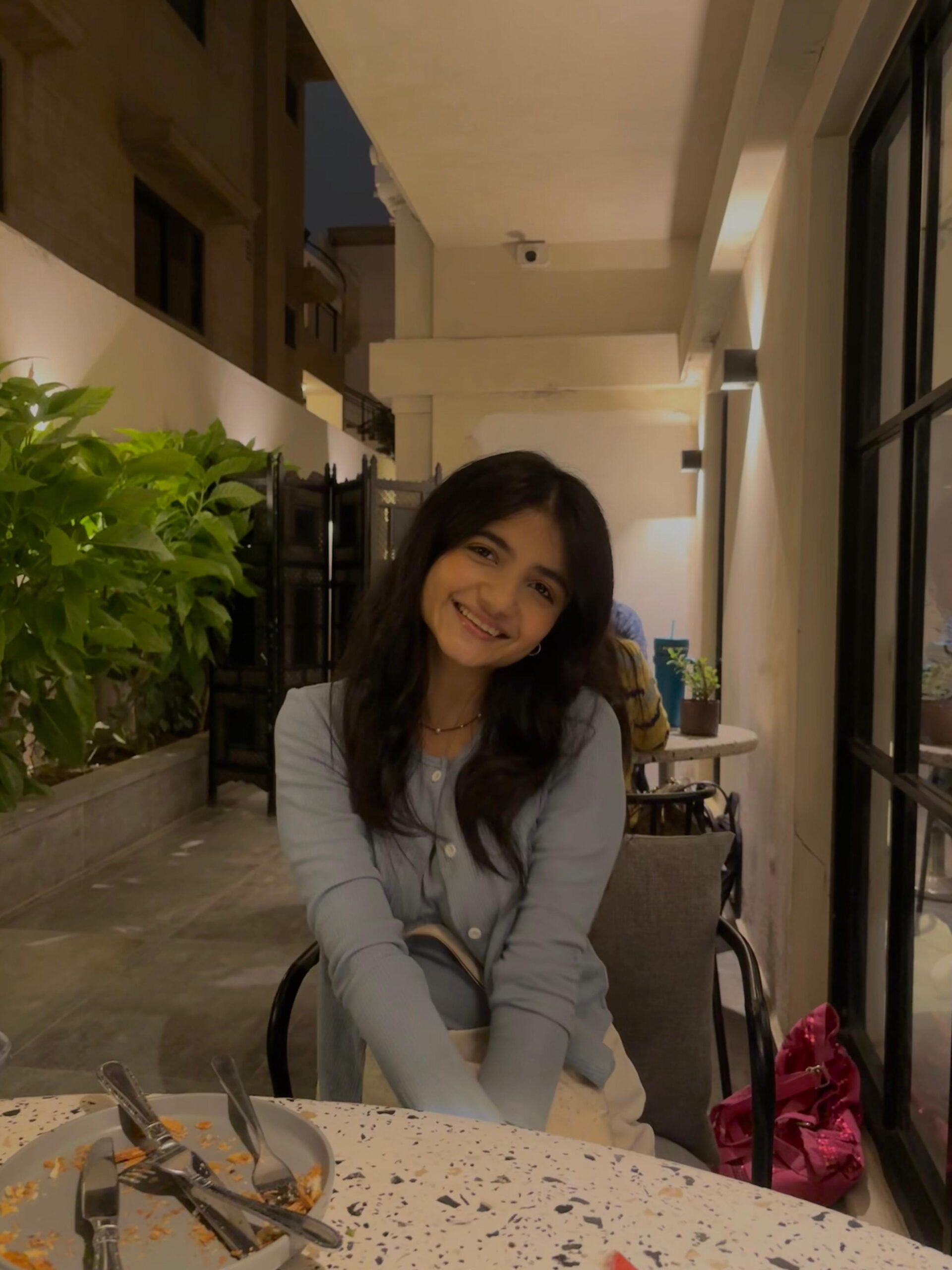
By: Aisha Esbhani
I often tell people that writing is my do-or-die. I cannot live without it – in a sticky spiritual sense, and now literally as well. It has become my source of income and sustenance, allowing me to become a financially independent woman in 2022 at the mere age of nineteen.
But beyond the credit I give to what writing has done for my life, I repeatedly get asked the same question: but why? Why do you write?
Some days, I go on a tangent about how writing is my means of introspection. When I write, the sky transforms into Daedalus and Icarus’ playground, and I’m left pondering – is it better to fly, or to take the leap and risk it all? When I write, I begin to notice the cracks in the road beneath me, and I think about how some cracks run a little deeper than others – how between India and Pakistan, too, lies just such a crack. When I write, the daffodils begin appearing like trumpets, and the blades of grass like miniature hands reaching up, asking for something I can’t quite name.
Some days, depending on who I’m speaking with, I take the LinkedIn route – explaining how writing has allowed me to move through marketing, HR, and corporate communication. How no field, really, can go without it.
And on other days, I speak of how writing makes me feel like a child again. How it pumps that youthful fervor, that desire, that adrenaline through my veins – making me want to write more and more and more, until I am physically out of words, until my tongue is parched and my fingers, crumpled.
But underneath all of these answers lives the same truth.
As students and professionals, we’ve been made to believe that we must be specialists. A physicist must have every law memorized, must understand quantum theory, must be able to calculate the center of mass – even if they don’t feel at the center of anything at all. Even if they’ve never stopped to wonder what actually lies beneath that center, what the earth holds in its core that no equation can reach. They must not ask, because it is beyond empirics. A biologist must know where every vein and artery lies, how the synapse fires, how a cell divides and conquers. But they must never ask what it takes for a mother to give a part of herself away to another, how she metamorphoses to form another.
We claim to be specialists, that we know everything within our fields. But we rarely stop to notice how narrow those fields really are – how we operate within institutions without questioning them. What would happen if we dismantled the systems we’ve inherited? What would a physicist do if the constants weren’t constant? What would the doctor feel if they were the patient, not the practitioner?
Specialization and expertise, in our day and era, is not about knowing too much about a field. It’s about digging so deep into such a small hole that that’s all you see.
This is why I write.
Writing refuses to let you stay in your hole. To write well, you must be willing to be many things at once. You must think like a scientist – curious, rigorous, unafraid of being wrong. You must see like an artist – noticing what others walk past, finding the trumpet in the daffodil. You must build like an architect or an engineer – with structure, intention, every word load-bearing. And you must feel like a human being – which is to say, you must be willing to be undone by things, and then package and put yourself back together on the page.
In the simplest words, to me, writing has never been a discipline. It is the refusal of singularity.
And so when I sit across from a student – nervous, rehearsed, already performing the version of themselves they think I want to see – and I tell them “there is a writer in you”, I am not talking about grammar or structure or college essays. What I’m saying is that I see you. I see the physicist who wonders what lies beneath the equation, and the center. I see the biologist who feels the affect even when positivist science rejects it – who questions why it’s butterflies in your stomach when we’re in glee and mice when we’re hungry. I see the child who wanted to be a flight attendant, the teenager who lost a night too deep into Greek mythology, the person who has loved many things and been made to feel that this is a flaw. Most importantly, I see the student who has never thought of themselves as a writer in the first place – who believes writing belongs to someone else, someone more certain, someone with a tidier story, and a conclusion.
But writing has always belonged to the uncertain. To the philosophers, activists, homemakers, historians, economists, the people with too many questions and not enough boxes to put them in. To the ones who feel things in their bodies before they can even name them. To the ones who are, in other words, fully human.
As a writer, let me tell you – this is not a flaw. It is the full shape of a person. And that is exactly where we begin our Common App process – and why we must all pursue writing as discovery: of a past you bear, a present you embody, and a future you hope for.